








 Author Affiliations
Abstract
Background: Work-life balance (WLB) plays a crucial role in preventing burnout and enhancing professional performance among nurses. Burnout, characterized by emotional exhaustion and depersonalization, negatively affects healthcare delivery.
Aim: The study aims to assess how WLB programs influence burnout and professional performance among nurses, identifying key benefits and challenges in their implementation.
Methodology: A mixed-method approach using an explanatory sequential design was employed. The quantitative phase involved a survey of 200 staff nurses, measuring burnout levels using the Maslach Burnout Inventory. The qualitative phase included semi-structured interviews with a subset of participants to explore their experiences with WLB programs. Descriptive and thematic analyses were used to interpret findings.
Results: Nurses with access to WLB programs reported significantly lower emotional exhaustion (mean = 19.4) and depersonalization (mean = 7.5) compared to those without access. Job satisfaction (mean = 80.2) and quality of patient care (mean = 82.0) were higher among nurses benefiting from WLB initiatives. Qualitative findings highlighted improved mental well-being, reduced stress, and enhanced professional commitment. However, barriers included departmental restrictions and a lack of awareness.
Conclusion: WLB programs effectively reduce burnout and improve professional performance. Healthcare institutions should implement and promote these initiatives to enhance nurse well-being and patient care outcomes.
Keywords
Work-life balance, Burnout, Nursing performance, Job satisfaction, Healthcare management.
Introduction
Three important concepts for the healthcare field, including nursing practice, involve work-life balance (WLB), burnout, and professional performance.[1] People must maintain a balance between their professional responsibilities and their personal and family life to avoid internal conflict and stress. Burnout functions as a psychological syndrome that emerges due to prolonged workplace stress, therefore leading to emotional exhaustion alongside depersonalization and poor personal accomplishments.[2] The skills required for professional nursing performance involve delivering excellent patient care in addition to maintaining strong communication while demonstrating advanced clinical abilities.[3] New research examines the effects of WLB programs on nurse burnout reduction and their contribution to improving nursing professionals’
performance.[4]
Emotional exhaustion stands as one of the main reasons behind nurse burnout, since 30% to 40% of healthcare providers report it after performing their duties.[5] The implementation of WLB programs by healthcare institutions resulted in decreased burnout levels among nurses who participated in these programs, reaching an emotional exhaustion of 19.4 and depersonalization of 7.5.[6] WLB programs enhance job satisfaction scores to (mean 80.2) while also improving patient care (mean 82.0) among their participants. The study demonstrates why organizations need WLB initiatives because they create better nursing well-being and enhance professional performance results.[7]
Nursing professionals must deal with heavy workloads that include extensive labor shifts while working amidst intense work environments. When nurses struggle to manage their professional duties with their home responsibilities, their mental state declines while stress rises until burnout develops.[8] Professional commitment decreases when nurses experience burnout since they develop more severe fatigue along with depression and anxiety, which hinders their healthcare delivery quality.[9] These effects create a chain reaction in health systems where burnout causes healthcare professionals to leave their jobs, skip work, and diminish their job satisfaction, thus reducing healthcare system performance.[10]
WLB programs, including flexible working hours, job-sharing options, and supportive policies regarding time off, are increasingly being introduced in healthcare settings to support nurses in managing their personal and professional lives.[11] These programs are believed to play a crucial role in reducing stress and preventing burnout by allowing nurses to recharge and maintain healthier lifestyles.[12] Nurses who have a good WLB report better psychological well-being, greater job satisfaction, and enhanced motivation in their professional roles.[13]
While various studies have investigated the impact of WLB on employee well-being in other sectors, there is a limited body of research focusing specifically on nurses. In particular, research on how WLB programs influence burnout levels and professional performance in nursing remains underexplored.[14] Understanding this relationship is essential to improving nursing practice and creating a sustainable healthcare workforce, especially in the context of global nursing shortages and increasing patient care demands.[15]
Research about the relationship between WLB and employee well-being exists in numerous sectors, yet there is a scarcity related to nurse-specific investigations. The precise relationship between WLB programs and burnout levels and professional performance in nursing has not received adequate scholarly investigation.[16] Analyzing this connection remains important for developing nursing practices alongside maintaining a permanent healthcare workforce because of the world nurse shortages and rising patient care needs.[17]
Methodology
This research adopted an explanatory sequential design within a mixed-methods approach. The study ensued through a dual-step process that employed both quantitative and qualitative research methodologies to examine the relationships between WLB programs and burnout and professional performance among nursing staff. The survey included 200 staff nurses from multiple departments working in Saidu Teaching Hospital, Swat, Pakistan.
Phase 1-Quantitative approach: The initial stage of the study operated with a quantitative examination method to gather numeric data. During this research phase, the relationship between WLB programs and burnout levels, alongside their effects on the professional performance of nurses, was assessed.
This research used a self-report questionnaire, which was distributed to participants through physically collected data. The researchers invited nurses as participants who decided freely to answer the survey, which ran from October 2024 through January 2025. Burnout levels and professional performance indicators, including job satisfaction, quality of patient care, and self-reported performance, formed the main target of quantitative data collection through the Maslach Burnout Inventory.
Phase 2-Qualitative approach: A qualitative research design was applied in study phase two to comprehend nurses’ experiences and perspectives on programs supporting WLB. A segment of the nurses who joined the quantitative phase took part in semi-structured interviews for this phase of the study. The interview process evaluated nurse perceptions about the connection between WLB programs and their effects on burnout alongside professional performance.
A thematic analysis explored detailed qualitative findings to reveal a deeper understanding of the WLB effects on nursing-related stress levels as well as job satisfaction and professional output. Explanatory data collected in the qualitative segment provided detailed explanations that enriched statistical results.
Study population: Saidu Teaching Hospital in Swat, Pakistan, included a total of 1300 beds as its main facility. The study included all staff nurses who directly attended patients in medical teams, surgical teams, obstetric teams, geriatric teams, intensive care unit teams, and operating theater teams. The staff nurse study included nurses who performed their work between adult and pediatric departments.
Participants joined voluntarily, and the investigators carried out the selection of participants. Staff nurses completed data collection surveys for the quantitative phase from October 2024 until January 2025. The selected nurses filled out their self-report questionnaires during their work at the hospital facility.
Data analysis: The study employed sequential mixed-methods analysis to handle its data. Analysis of self-report questionnaire data occurred in the quantitative phase through descriptive statistics that presented key variables and demographic information. The qualitative stage involved using descriptive thematic analysis to evaluate transcripts from nurse and nurse manager semi-structured interviews. The research team developed themes through data induction to explore burnout and workload as well as job satisfaction in relation to WLB.
Result
Demographic characteristics: The participants consisted of 58% female and 42% male nurses. Most participants (72%) were aged between 25-40 years, with the remaining 28% aged 41 years and above. In terms of experience, 36% had 6 to 10 years, 25% had 6 months to 5 years, 24% had 11 to 15 years, and 15% had over 16 years of experience (Table 1).
| Variable | Frequency | Percentage |
| Gender | ||
| Female | 116 | 58 |
| Male | 84 | 42 |
| Age | ||
| 25-40 years | 144 | 72 |
| 41 years and above | 56 | 28 |
| Years of experience | ||
| 6 months to 5 years | 50 | 25 |
| 6 to 10 years | 72 | 36 |
| 11 to 15 years | 48 | 24 |
| 16 years and above | 30 | 15 |
Table 1: Demographic characteristics of the participants
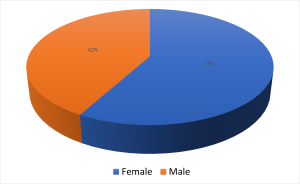
Figure 1: Gender of participants
The burnout levels among nurses showed moderate emotional exhaustion (mean = 23.5) and low depersonalization (mean = 9.7), with high personal accomplishment (mean = 32.8). Nurses reported moderate to high professional performance, including job satisfaction (mean = 75.3), quality of patient care (mean = 80.1), and self-reported performance (mean = 78.5). Overall, the results suggest a mix of burnout symptoms and positive professional performance (Table 2).
| Component/Performance indicator | Mean | Standard deviation (SD) |
| Burnout levels (Maslach burnout inventory) | ||
| Emotional exhaustion | 23.5 | 5.1 |
| Depersonalization | 9.7 | 3.4 |
| Personal accomplishment | 32.8 | 6.3 |
| Professional performance scores | ||
| Job satisfaction | 75.3 | 10.5 |
| Quality of patient care | 80.1 | 8.3 |
| Self-reported performance | 78.5 | 7.9 |
Table 2: Burnout levels and professional performance scores
Nurses with access to WLB programs reported lower emotional exhaustion and depersonalization, along with higher job satisfaction and quality of patient care compared to those without access (Table 3).
| Group | Emotional Exhaustion (Mean, SD) | Depersonalization (Mean, SD) | Job Satisfaction (Mean, SD) | Quality of Patient Care (Mean, SD) |
| Access to Work-Life Balance Programs | 19.4 (5.0) | 7.5 (2.9) | 80.2 (9.3) | 82.0 (7.5) |
| No Access to Work-Life Balance Programs | 26.7 (5.8) | 10.8 (3.6) | 71.1 (11.0) | 77.3 (9.6) |
| p-value | < 0.01 | < 0.05 | < 0.05 | < 0.01 |
Table 3: Burnout levels and professional performance by access to WLB programs
Nurses with access to WLB programs reported reduced stress, improved mental health, higher job satisfaction, and enhanced professional performance, including better patient care. However, some faced challenges accessing these programs due to departmental limitations and a lack of awareness. Despite these barriers, the overall impact was positive, benefiting both personal well-being and job outcomes (Table 4).
| Theme | Description | Quote |
| Reduced stress and improved mental health | Nurses with access to WLB programs reported lower stress levels and better mental health. | “Having flexible hours has allowed me to manage my family responsibilities better, which has reduced my stress levels and improved my overall well-being.” |
| Increased job satisfaction | WLB programs were associated with higher job satisfaction, as nurses felt more balanced between work and personal life. | “I feel more satisfied with my job since the program was introduced. It allows me time to rest and spend time with my family, which makes me more committed at work.” |
| Improved professional performance | Nurses reported enhanced job performance, including better patient care, due to reduced stress and increased motivation from WLB programs. | “I perform better at work now that I have time to recharge. It’s easier to focus on patient care when I’m not feeling overwhelmed.” |
| Barriers to program access | Some nurses reported challenges in accessing WLB programs due to departmental limitations or a lack of awareness. | “Not all departments offer flexible working hours, and sometimes it’s hard to negotiate the time off I need.” |
Table 4: Themes of qualitative interviews
Discussion
Research results demonstrate that WLB programs generate substantial changes in burnout levels, together with professional performance outcomes within nursing staff. Nurses who had WLB programs in their care institution showed decreased emotional exhaustion and depersonalization compared to nurses without such benefits in their workplace. WLB initiatives show the same effectiveness as documented research, identifying them as vital tools to fight burnout among medical staff.[18] Research evidence demonstrates that employees achieve enhanced emotional well-being, together with lower burnout, through programs that offer work hour flexibility, stress reduction, and adequate rest opportunities.[19]
WLB directly influenced job satisfaction levels based on the findings of this research study. Research findings support these results, showing that nurses with access to WLB programs achieved higher job satisfaction levels because WLB positively impacts employee morale, according to previous studies.[20] Workplace satisfaction serves as an essential component for healthcare employee maintenance, since contented professionals show lower levels of burnout and choose to continue their nursing profession. The findings match healthcare settings, which demonstrate that WLB programs increase job satisfaction along with organizational commitment, leading to greater motivation among nurses.[21]
Nurses who use WLB programs deliver improved quality of care to patients while additionally showing better performance outcomes at work. Research studies have established that healthcare institutions operating balanced working environments produce better employee performance results.[22] The implementation of WLB programs cuts both burnout and stress, which enables nurses to deliver tasks more energetically and focus on producing superior patient care. Work-related stress and burnout together negatively affect attention to patients and quality performance, which reinforces the need for organizations to establish WLB programs.[23]
WLB programs create positive effects on nurse well-being, which become clearer through this study’s qualitative information. Nursing staff benefited from adaptable scheduling, which enabled them to handle family matters better, thus reducing their pressure and improving their mental state. Research by other authors supports these findings, which show nursing staff benefit from flexible scheduling systems because flexibility reduces stress levels and increases satisfaction levels.[24] Research participants demonstrated enhanced focus on patient care as work-life integration led to improved personal reenergization, according to their reports.[25]
Research indicates that WLB programs yield mostly positive results. However, this study discovered various impediments that restrict employees from utilizing these initiatives. The implementation of WLB policies was restricted for some nurses because of departmental limitations and insufficient awareness about available programs.[26] The research aligns with existing reports demonstrating that deficient communication, combined with insufficient managerial support and insufficient staffing, are major impediments to healthcare WLB program success. Strategies to remove these operational obstacles will guarantee that all nursing staff receive program benefits, regardless of their department affiliation or job level in the organization.[27]
The study revealed organization-wide barriers that require healthcare organizations to adopt strategic measures to improve nurse access to WLB initiatives. The successful implementation of WLB solutions in healthcare settings requires programs to get widespread communication support with sufficient resources and a work environment that endorses WLB practices.[28] Program accessibility combined with management commitment helps provide solutions that address program uptake barriers, according to research findings. Organizations must take these barriers seriously because WLB programs need proper integration into routine nursing practice.[29]
Conclusion
The research data indicates that WLB initiatives create positive effects on nurse burnout management while bolstering their work performance. This research joins other studies that provide support to healthcare organizations that adopt WLB policies. The challenges that nurses face when trying to access these WLB programs cannot detract from the many advantages that enable better burnout reduction while simultaneously producing significant job satisfaction improvements and superior patient care results, thus supporting mass implementation across nursing practice. Researchers should study how nurse retention changes following WLB initiatives while working to find solutions for restricted access challenges to these programs.
Limitations: This study has several limitations that should be considered. Since data were collected from a single hospital, the findings may not be generalizable to other healthcare settings. The employment of self-reported data along with convenient sampling creates possible bias effects while failing to fully represent an extensive nursing workforce. The study did not examine organizational elements that could influence the success of the WLB program. Future research needs to address these weaknesses through the use of multiple hospitals, extensive time periods, diverse populations, and random selection methods to evaluate organizational support initiatives.
References
- Rao A, Shailashri. Work-Life Balance of women medical professionals in the healthcare sector-A systematic literature review. Int J Health Sci Pharm. 2021:54-79. doi.10.47992/ijhsp.2581.6411.0074 Crossref | Google Scholar
- Bhende P, Mekoth N, Ingalhalli V, Reddy YV. Quality of work life and work–life balance. J Hum Values. 2020;26(3):256-265. doi.10.1177/0971685820939380 Crossref | Google Scholar
- Muthuswamy VV. Saudi Female health workers job performance: Examining the Influence of job burnout (JB), work-life balance (WLB), and work environment (WE). Przestrzeń Społeczna (Social Space). 2022;22(3) Saudi Female health workers job performance: Examining the Influence of job burnout (JB), work-life balance (WLB), and work environment (WE)
- Dousin O, Collins N, Bartram T, Stanton P. The relationship between work-life balance, the need for achievement, and intention to leave: Mixed-method study. J Adv Nurs. 2021;77(3):1478-1489. doi.10.1111/jan.14724
PubMed | Crossref | Google Scholar - Kabunga A, Kigongo E, Okalo P, et al. Burnout and quality of life among healthcare workers in central Uganda. PLoS One. 2024;19(8):e0305713. doi.10.1371/journal.pone.0305713 PubMed | Crossref | Google Scholar
- Galanis P, Moisoglou I, Katsiroumpa A, et al. Increased Job Burnout and Reduced Job Satisfaction for Nurses Compared to Other Healthcare Workers after the COVID-19 Pandemic. Nurs Rep. 2023;13(3):1090-1100. doi.10.3390/nursrep13030095 PubMed | Crossref | Google Scholar
- Alreshidi NM, Alsharari AF. Work-life balance of expatriate nurses working in acute care settings. Nurs Open. 2021;8(6):3201-3211. doi.10.1002/nop2.1033 PubMed | Crossref | Google Scholar
- Kumar M, Saini A, Jeet K. Sustaining mental health amidst high-pressure job scenarios: a narrative review. Int J Community Med Public Health. 2024;11(8):3319-3325. doi.10.18203/2394-6040.ijcmph20242197
Crossref | Google Scholar - Ablaza CJ, Abutin M, Agunos AJ, et al. Voices from the frontlines: The lived experiences of nurses working overtime amid the covid-19 pandemic. Eur J Public Health Stu 2025;8(1):118-132. Voices from the frontlines: The lived experiences of nurses working overtime amid the covid-19 pandemic
- Goudarzian AH, Nikbakht Nasrabadi A, Sharif-Nia H, Farhadi B, Navab E. Exploring the concept and management strategies of caring stress among clinical nurses: a scoping review. Front Psychiatry. 2024;15:1337938. doi.10.3389/fpsyt.2024.1337938 PubMed | Crossref | Google Scholar
- Dulko D, Kohal BJ. How Do We Reduce Burnout In Nursing?. Nurs Clin North Am. 2022;57(1):101-114. doi.10.1016/j.cnur.2021.11.007 PubMed | Crossref | Google Scholar
- Pagador F, Barone M, Manoukian M, Xu W, Kim L. Effective Holistic Approaches to Reducing Nurse Stress and Burnout During COVID-19. Am J Nurs. 2022;122(5):40-47. doi.10.1097/01.NAJ.0000830744.96819.dc
PubMed | Crossref | Google Scholar - Rashmi K, Kataria A. The mediating role of work-life balance on the relationship between job resources and job satisfaction: perspectives from Indian nursing professionals. Int J Organ Anal. 2023;31(5):1316-1342. doi.10.1108/ijoa-04-2021-2722 Crossref | Google Scholar
- Xiao Q, Cooke FL, Chen L. Nurses’ well‐being and implications for human resource management: A systematic literature review. Int J Manag Rev. 2022;24(4):599-624. doi.10.1111/ijmr.12295 Crossref | Google Scholar
- Gribben L, Semple CJ. Factors contributing to burnout and work-life balance in adult oncology nursing: An integrative review. Eur J Oncol Nurs. 2021;50:101887. doi.10.1016/j.ejon.2020.101887 PubMed | Crossref | Google Scholar
- Boamah SA, Hamadi HY, Havaei F, Smith H, Webb F. Striking a Balance between Work and Play: The Effects of Work-Life Interference and Burnout on Faculty Turnover Intentions and Career Satisfaction. Int J Environ Res Public Health. 2022;19(2):809. doi.10.3390/ijerph19020809 PubMed | Crossref | Google Scholar
- Akinwale OE, Edegwa SK, Ofuani AB. Individual and organisational determinants of work-life balance and quality of work-life (Qwl) among nurses and pharmacists in government hospital. Afr J Econ Bus Res. 2024;3(2). doi.10.4314/ajebr.v3i2.3 Crossref | Google Scholar
- Steketee A, Chen S, Nelson RA, Kraak VI, Harden SM. A mixed-methods study to test a tailored coaching program for health researchers to manage stress and achieve work-life balance. Transl Behav Med. 2022;12(3):369-410. doi.10.1093/tbm/ibab134 PubMed | Crossref | Google Scholar
- Poulin PA, Mackenzie CS, Soloway G, Karayolas E. Mindfulness training as an evidence-based approach to reducing stress and promoting well-being among human services professionals. Int J Health Promot Educ. 2008;46(2):72-80. Mindfulness training as an evidence-based approach to reducing stress and promoting well-being among human services professionals
- Hassan Helaly S, Ismail Ali H, Abdel Ghafar Ali K, Mohammed Aysha Z, Elgharib Mohamed Mostafa Eldiasty N. Effect of nursing activities on the quality of work-life balance, absenteeism, and job satisfaction among nurses at intensive care units. Egypt J Health Care. 2022;13(1):2011-2029. doi.10.21608/ejhc.2022.269778 Crossref | Google Scholar
- Aruldoss A, Berube Kowalski K, Travis ML, Parayitam S. The relationship between work–life balance and job satisfaction: moderating role of training and development and work environment. J Adv Manag Res. 2022;19(2):240-271. doi.10.1108/jamr-01-2021-0002 Crossref | Google Scholar
- Cohen C, Pignata S, Bezak E, Tie M, Childs J. Workplace interventions to improve well-being and reduce burnout for nurses, physicians and allied healthcare professionals: a systematic review. BMJ open. 2023;13(6):e071203. doi.10.1136/bmjopen-2022-071203 PubMed | Crossref | Google Scholar
- Fazal S, Masood S, Nazir F, Majoka MI. Individual and organizational strategies for promoting work–life balance for sustainable workforce: A systematic literature review from Pakistan. Sustainability. 2022;14(18):11552. doi.10.3390/su141811552 Crossref | Google Scholar
- Lee HF, Chang YJ. The Effects of Work Satisfaction and Work Flexibility on Burnout in Nurses. J Nurs Res. 2022;30(6):e240. doi.10.1097/jnr.0000000000000522 PubMed | Crossref | Google Scholar
- Sullivan AB, Davin SA, Lapin B, et al. Effects of flexible scheduling and virtual visits on burnout for clinicians: 1- year follow-up. Mult Scler Relat Disord. 2023;75:104721. doi.10.1016/j.msard.2023.104721 PubMed | Crossref | Google Scholar
- Okemwa DO. Influence of Work-Life Balance Initiatives on Commitment of Nurses in Public Hospitals in Kenya. Doctoral dissertation. Jomo Kenyatta University; 2022. Influence of Work-Life Balance Initiatives on Commitment of Nurses in Public Hospitals in Kenya
- Omar WRW, Zaid DDM, Mohamad N, Ismail Z. Conceptualizing the Impact of Work-Life Balance on Job Satisfaction – Can the Issues be resolved among Nurses? J Emerg Econ Islam Res. 2021;9(1):1-15. Conceptualizing the Impact of Work-Life Balance on Job Satisfaction – Can the Issues be resolved among Nurses
- Cvenkel N. Work-life balance and well-being at work: Employees’ perspective to promote a psychologically healthy workplace. The Palgrave Handbook of Corporate Social Responsibility. Springer International Publishing; 2020:1-23. Crossref | Google Scholar
- Bartlett MJ, Arslan FN, Bankston A, Sarabipour S. Ten simple rules to improve academic work-life balance. PLoS Comput Biol. 2021;17(7):e1009124. doi.10.1371/journal.pcbi.1009124 PubMed | Crossref | Google Scholar
Acknowledgments
Not reported
Funding
Not reported
Author Information
Corresponding Author:
Shah Hussain
Department of Nursing
Zalan College of Nursing Swat, Pakistan
Email: [email protected]
Co-Authors:
Muhammad Anwar
Department of Nursing
Medtach College of Nursing Dir, Pakistan
Arif Ullah
Department of Quality Improvement & Patient Safety
Lady Reading Hospital, Peshawar, Pakistan
Wasim Ullah
Department of Nursing
Peshawar Institute of Cardiology, Pakistan
Habiba Gul
Department of Nursing
Rehman Medical Institute Peshawar, Pakistan
Nisar Khan
Department of Nursing
United College of Nursing, Swat, Pakistan
Authors Contributions
Shah Hussain was responsible for data collection, data analysis, and manuscript write-up. Muhammad Anwar contributed to data collection and thematic analysis. Arif Ullah handled data collection and statistical analysis. Wasim Ullah, Habiba Gul, and Nisar Khan were involved in data collection.
Ethical Approval
Before the study execution, the Saidu Teaching Hospital Swat Institutional Review Board (IRB) provided ethical approval (Ref. No SGTH 2024/28), which was accompanied by an informed consent form explaining the research purpose and procedure, along with explaining risks to potential participants. The study allowed free choice of participation with complete freedom for any participant to leave the research at their discretion. All information received is treated anonymously before being stored securely.
Conflict of Interest Statement
The authors declare no conflicts of interest.
Guarantor
None
DOI
Cite this Article
Shah H, Muhammad A, Arif U, Wasim U, Habiba G, Nisar K. The effect of work-life balance programs on burnout levels and professional performance among nurses: A mixed-method study at Saidu Teaching Hospital Swat, Pakistan. medtigo J Med. 2025;3(1):e30623134. doi:10.63096/medtigo30623134 Crossref