








 Author Affiliations
Abstract
Background: Kidney stones and urinary tract infections (UTIs) are two of the most common urologic conditions, both of which have been shown to exhibit seasonal patterns in incidence with higher rates during warmer months. Understanding public engagement with these conditions, especially through online search behavior, may offer insight into when interest, awareness, or symptom occurrence is most likely to rise.
Objective: The objective of this study is to evaluate seasonal variation in public interest for kidney stones and urinary tract infections using Google Trends data from 2004 to 2023.
Methodology: Monthly Google Trends data (2004–2023) were collected for the search terms “kidney stones,” “urinary tract infection,” and “UTI” within the United States. Search Volume Index (SVI) values (0–100 scale) were averaged by calendar month to assess seasonal trends. The highest monthly SVI for each term in the 20-year period was set to 100, with all other values scaled proportionally.
Results: Public interest peaked in July for “kidney stones” (average SVI 60.3), “UTI” (abbreviation, average SVI 54.2), and “urinary tract infection” (average SVI 71.2). All three search terms showed elevated interest from late spring through summer, with the lowest interest observed during the winter months.
Conclusion: Public interest in kidney stones and UTIs demonstrates clear seasonal variation, peaking during the summer months. These patterns suggest that digital search behavior may reflect underlying seasonal shifts in disease awareness or incidence. Leveraging this information could improve the timing of public health education and resource allocation for these urologic conditions.
Keywords
Urology, Google trends, Public interest, Seasonal variation, Urinary tract infection, Kidney stones.
Introduction
Seasonal changes have well-documented impacts on health, as variations in temperature and humidity influence the incidence and severity of certain medical conditions. For urologic conditions like kidney stones and urinary tract infections (UTIs), warmer weather months are associated with increased occurrence, likely due to factors such as dehydration, dietary changes, and heightened bacterial proliferation. Understanding these patterns is essential for developing timely and targeted public health initiatives to optimize awareness, prevention, and management efforts.
This study leverages Google Trends data to explore public interest in kidney stones and UTIs over the period from 2004 through 2023. By examining fluctuations in online search volumes for these conditions, we aim to gain insights into broader patterns of seasonal variation in public awareness. Such knowledge has significant implications for public health messaging, allowing healthcare professionals to align educational campaigns with times of increased relevance. It is important to note that while Google Trends is a powerful tool for monitoring population-level health interest, its data can be influenced by media coverage and other external factors. Results should therefore be interpreted with these limitations in mind.[1]
Uncomplicated UTIs are among the most common bacterial infections in clinical practice.[2] They primarily affect the lower urinary tract (e.g., bladder), with symptoms such as urinary frequency, urgency, suprapubic discomfort, and dysuria. Bacteriuria or pyuria in the absence of symptoms does not constitute a UTI. Uncomplicated UTIs occur in otherwise healthy individuals with no major comorbidities or structural abnormalities. Although some cases may resolve spontaneously, many patients seek treatment for symptom relief and to prevent complications. Prompt and accurate diagnosis is essential for appropriate management.
Renal calculi (kidney stones) are a common cause of hematuria and flank, abdominal, or groin pain.[3] Kidney stones affect roughly 1 in 11 people during their lifetime, with men about twice as likely to form stones as women. Stone development is associated with factors that concentrate the urine or promote crystal formation: decreased urine volume (often from inadequate fluid intake) and increased excretion of substances like calcium, oxalate, uric acid, and phosphate. Low urinary citrate or high urinary acidity can also contribute. Dietary factors and certain medications may modify stone risk.
Seasonal variations appear to significantly influence the incidence of both kidney stones and UTIs, primarily due to changes in physiological and environmental factors. During warmer months, higher temperatures lead to increased sweating and consequent dehydration, resulting in concentrated urine that facilitates precipitation of urinary crystals such as calcium oxalate, calcium phosphate, and uric acid. Warm climates are also associated with greater consumption of sugary beverages and oxalate- or sodium-rich foods, further elevating kidney stone risk.[4] Similarly, elevated temperatures promote bacterial proliferation, particularly of Escherichia coli, the primary pathogen in UTIs, while increased recreational water exposure and dehydration-related reductions in urinary flushing can further raise infection risk.[5]
In this context, we explore the seasonal variation in public interest for kidney stones and UTIs using Google Trends data spanning 2004 to 2023. We hypothesize that search query patterns will exhibit seasonal peaks that correspond to known seasonal fluctuations in actual disease occurrence. Demonstrating such a correlation would suggest that Google search behavior might serve as a proxy for public awareness or even an underlying symptom burden in the population.
With the ubiquity of internet access and smartphones, individuals increasingly turn to online platforms like Google for health information. Public health agencies could potentially leverage these digital behavior patterns by timing education and prevention efforts to coincide with periods of peak public interest. For example, campaigns between June and August might yield greater engagement. Prior studies show that well-timed educational interventions can promote preventive health behaviors.[6] Using Google Trends to identify when the public is most concerned about certain conditions provides an opportunity to optimize the timing of such interventions for maximum impact.
Methodology
Google Trends is a publicly available tool that provides access to the relative search volume of specific terms over time. It reports values as a search volume index (SVI) from 0 to 100, representing search interest relative to the peak volume within the specified timeframe and region. For this study, we used Google Trends to analyze public interest in two common urological conditions: kidney stones and urinary tract infections. We collected monthly SVI data for three search terms: “kidney stones,” “urinary tract infection,” and “UTI” to capture both formal and colloquial search behavior. All data were restricted to searches originating in the United States. The timeframe queried was January 2004 through December 2023 (a 20-year span).
Using the Google Trends web interface, we obtained the monthly SVI values for each term and exported the data to Microsoft Excel. To evaluate seasonality, we averaged the SVI for each calendar month across all years (e.g., averaging all January values from 2004–2023, all February values, etc.). This averaging by month-of-year allowed us to identify consistent seasonal patterns by smoothing out year-to-year noise. Because Google Trends SVI values are normalized such that the single highest-interest month in the time is 100, these averaged values reflect relative interest (not absolute search counts). We then compared the average SVI across months to determine which months showed the highest and lowest interest on average over the 20-year period. We interpreted months with the highest average SVI as periods of peak public concern or awareness of that condition. For the purposes of seasonal classification, we defined “winter” as December through March to capture the broader period of colder temperatures that influence behavior and health patterns across much of the United States. This approach allows for more consistent interpretation of seasonal search trends, particularly for conditions like UTIs and kidney stones that may respond to temperature-related factors.
No additional statistical tests were performed; the analysis is descriptive, focusing on the magnitude and timing of peak interest. Given the aggregated nature of the data and our focus on seasonal trends, formal statistical comparisons were not conducted, as they were not deemed necessary for identifying broad patterns. All data used were aggregated and anonymous, so this study did not involve human subjects as defined in clinical research.
Results
Analysis of Google Trends data from 2004 to 2023 revealed distinct seasonal patterns in public search interest for both kidney stones and urinary tract infections. Figure 1 illustrates the monthly average SVI for the search terms over the 20-year period.
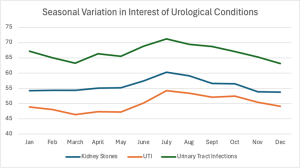
Figure 1: Monthly average Google SVI for “kidney stones,” “UTI,” and “urinary tract infection” in the United States (2004–2023)
For kidney stones, public interest began to rise in the spring and reached a sustained increase starting in May (average SVI 55.15). Interest peaked in July, with an average SVI of 60.3, and remained elevated through August (59.05). The lowest average interest occurred in December (SVI 53.80). This seasonal pattern in searches aligns with known risk factors for stone formation, such as increased dehydration and dietary changes during the hotter months.
UTI-related search interest showed a similar trend, though more pronounced. For the search term “urinary tract infection,” average public interest was relatively low in the winter, then rose sharply starting in April (SVI 66.35) and continued to climb to a peak in July (SVI 71.2). After July, interest gradually declined through the fall months. Notably, interest remained relatively high even until September (SVI 68.70) before dropping toward the yearly low in December (SVI 63.20). The search term “UTI” (the abbreviation) demonstrated a similar pattern of summer peak: although the average monthly relative SVI values for “UTI” searches were numerically lower (since “UTI” is a separate query with its own scale), it, like “urinary tract infection,” peaked in July and showed a seasonal dip during the winter months, with the lowest average occurring in March (SVI 46.2).
Importantly, both the full term “urinary tract infection” and its abbreviation “UTI” showed consistent seasonal peaks. This reinforces that the observed pattern is robust across different ways the public might search for this topic. In both cases, the late spring and summer months exhibit the highest relative search interest, suggesting that those are times when public concern or awareness about UTIs is greatest.
Taken together, these results indicate a clear association between warmer months and heightened public interest in these urologic conditions. Peak interest for both kidney stones and UTIs occurs during summer, and the trough of interest occurs during the winter months. The concurrence of the timing (summer highs, winter lows) across two distinct conditions and multiple search terms points to a broad seasonal effect in health information-seeking behavior.
Discussion
The findings of this infodemiology study highlight a significant seasonal trend in public interest for both kidney stones and urinary tract infections. The peak search interest for each condition was observed during the summer months. These patterns are consistent with clinical and epidemiological data suggesting that the incidence of these conditions is higher in warmer weather.
For kidney stones, elevated temperatures can lead to increased perspiration and dehydration, which in turn concentrates the urine and promotes the formation of crystals such as calcium oxalate, one of the most common constituents of kidney stones. This mechanism provides a biological explanation for why kidney stone cases (and thus public interest in kidney stones) might spike in the summer.[4] Similarly, UTIs may rise in frequency during the summer due to a combination of factors: warmer temperatures that encourage bacterial growth, more frequent participation in water-based recreational activities (which can introduce pathogens or alter normal flora), and dehydration that reduces urinary flushing of bacteria. These factors contribute to a higher incidence of UTIs in summer months, which aligns with the increase in UTI-related research observed from April through July.[5,7,8] The trend in our data is a sharp rise in UTI search interest from spring to summer, which closely aligns with these established high-risk periods for infection.
Notably, our results showed consistent patterns between both the formal term “urinary tract infection” and the abbreviated “UTI,” suggesting that the seasonal effect is not an artifact of a particular search term but rather reflects a true increase in public interest. This consistency across search behavior reinforces the potential of using Google Trends as a surrogate measure for public awareness or even symptom burden related to these conditions. While Google Trends does not provide absolute search volumes, supplementary tools suggest that “UTI” is searched for more frequently overall than “urinary tract infection,” likely due to its brevity and widespread colloquial use.
These insights present valuable opportunities for public health planning. For example, hydration-focused awareness campaigns could be strategically timed to precede the summer surge in kidney stone cases (e.g., launching in late spring). Similarly, efforts to educate individuals, especially women, who are disproportionately affected by UTIs on preventive strategies such as adequate hydration, proper hygiene, and early symptom recognition may have a greater impact if rolled out during the late spring or early summer, just before UTI incidence typically rises. By timing educational interventions with the period when public interest is naturally peaking, health communicators can capture the audience when they are most receptive and concerned about the topic.
Our findings also align with broader research on seasonality and urologic disease. Globally, studies have noted that the incidence of renal colic (kidney stone emergencies) and kidney stone disease tends to peak during warmer months, supporting a correlation between higher ambient temperatures and increased stone formation.[4] Furthermore, climate change projections indicate that rising global temperatures may expand the high-risk season or geographic zones for nephrolithiasis (kidney stones), potentially increasing the affected population in the coming decades.[9] In other words, if summers become longer or hotter, we might expect even more pronounced seasonal patterns or overall higher incidence of stone disease in the future. While our study looked at search interest as a proxy for disease, these climate considerations suggest that public interest may continue to track these trends and could even become more pronounced as climate-related changes unfold.
Limitations
While this study reveals strong and consistent seasonal patterns in search interest, several limitations inherent to Google Trends data must be acknowledged. First, SVI reflects relative search behavior, not the absolute incidence of disease. A higher search volume does not necessarily mean more cases are occurring; it indicates greater public interest or concern, which could be influenced by factors like media coverage, public health campaigns, or even a prominent individual’s experience shared publicly. Thus, search peaks could in part reflect awareness events or news, not just true disease rates.
Second, Google’s user base and search behavior can vary by demographic factors. Age, geographic location, socioeconomic status, and access to the internet all influence who is searching for health information. Our data, focused on the U.S., do not account for regional climate differences within the country or demographic differences in internet use. This could bias the representation of interest. For instance, older individuals or those without reliable internet may not be represented in Google Trends data, even though they experience UTIs or kidney stones.
Third, we did not directly compare the Google Trends data to clinical data (such as monthly emergency department visits for renal colic or recorded monthly diagnoses of the search terms from a large database). A parallel analysis of actual incidence or hospital admission data for UTIs and kidney stones by month would strengthen the validation of our findings. Such an analysis is a suggested avenue for future research to see how closely the search interest correlates with real-world case numbers. Additionally, our method averaged two decades of data, which smooths out year-specific anomalies but also assumes the seasonal pattern is stable over time. It’s possible that the magnitude of seasonal interest has changed over the years (for example, overall interest in “UTI” might be higher now than in the early 2000s due to greater internet usage). We primarily aimed to establish that a seasonal pattern exists; quantifying year-by-year trends was beyond our scope.
Finally, our analysis was limited to three specific search terms. There may be other related queries (e.g., “bladder infection” as a synonym for UTI, or “kidney pain”) that could also reflect interest in these conditions. Including more search terms or using Google’s category/topic feature could capture a broader picture of public interest. We chose the terms that we felt best represented the conditions and had high relevance. Additionally, the term “UTI” is broad, encompassing both lower and upper urinary tract infections. Our search data for “UTI” therefore captures combined interest in all types of urinary tract infections rather than any specific subtype.
Despite these limitations, the consistency and biological plausibility of the observed patterns suggest that the signal is genuine. Future studies can build on this work by integrating search data with clinical surveillance and exploring interventions timed to these patterns.
Conclusion
This study demonstrates a clear seasonal pattern in public interest related to kidney stones and urinary tract infections, with peak search activity occurring during the summer months. Average Google Trends search volume indices for both conditions reached their highest levels in July (60.3 for “kidney stones” and 71.2 for “urinary tract infection”), reinforcing a strong association between warmer weather and increased public engagement with these topics. This trend was observed consistently across both formal (“urinary tract infection”) and informal (“UTI”) search terms, adding confidence that the finding is robust.
These findings carry important implications for public health planning and education. Interventions such as hydration campaigns, ensuring access to clean drinking water, and targeted awareness messaging can be strategically timed to align with the observed seasonal spikes in interest and, potentially, in disease incidence. Tailored educational efforts — particularly for at-risk groups (for example, reminding women and young adults about UTI prevention as summer approaches) — may be more impactful when launched just before or during peak interest months.
Healthcare providers, school and college health services, and community health organizations could collaborate on programs that promote adequate water intake, healthy dietary choices, personal hygiene, and early recognition of symptoms during these high-interest periods. By providing accurate and relevant health information at times when the public is actively seeking it, we may encourage earlier healthcare seeking and reduce preventable complications from these conditions.
While our study focused on digital search interest rather than confirmed clinical diagnoses, the parallel seasonal patterns observed suggest that public search behavior can serve as a useful proxy for anticipating real-world health trends. However, it is important to note that these data reflect public interest or awareness, which may correlate with but do not directly measure disease incidence. Recognizing and harnessing this layer of population-level engagement can help shape smarter and better-timed health communication strategies. In essence, Google Trends data offer a way to “take the pulse” of public concern, allowing health initiatives to reach people at moments of peak interest, when they are most likely to engage, learn, and act on the information.
References
- Mavragani A, Ochoa G. Google Trends in infodemiology and infoveillance: methodology framework. JMIR Public Health Surveill. 2019;5:e13439. doi:10.2196/13439 PubMed | Crossref | Google Scholar
- Bono MJ, Leslie SW, Reygaert WC. Uncomplicated urinary tract infections. eBook. StatPearls Publishing; 2025. Uncomplicated urinary tract infections
- Leslie SW, Sajjad H, Murphy PB. Renal calculi (nephrolithiasis). eBook. StatPearls Publishing; 2025. Renal calculi (nephrolithiasis)
- Tasian GE, Pulido JE, Gasparrini A, et al. Daily mean temperature and clinical kidney stone presentation in five U.S. metropolitan areas: a time-series analysis. Environ Health Perspect. 2014;122:1081-1087. doi:10.1289/ehp.1307703 PubMed | Crossref | Google Scholar
- Simmering JE, Polgreen LA, Cavanaugh JE, Erickson BA, Suneja M, Polgreen PM. Warmer weather and the risk of urinary tract infections in women. J Urol. 2021;205:500-506. doi:10.1097/JU.0000000000001383 PubMed | Crossref | Google Scholar
- Ahmadi Z, Shamsi M, Roozbahani N, et al. The effect of an educational intervention on promoting preventive behaviors of urinary tract infection in adolescent girls: a randomized controlled trial. BMC Pediatr. 2020;20:79. doi:10.1186/s12887-020-1981-x PubMed | Crossref | Google Scholar
- Rosello A, Pouwels KB, Domenech de Cellès M, et al. Seasonality of urinary tract infections in the United Kingdom in different age groups: longitudinal analysis of The Health Improvement Network (THIN). Epidemiol Infect. 2018;146:37-45. doi:10.1017/S095026881700259X PubMed | Crossref | Google Scholar
- Simmering JE, Sewell D, Polgreen L, Polgreen PM. Urinary tract infection incidence is associated with recent environmental temperatures. Open Forum Infect Dis. 2018;5(Suppl 1):S8-9. doi:10.1093/ofid/ofy209.017 Crossref | Google Scholar
- Brikowski TH, Lotan Y, Pearle MS. Climate-related increase in the prevalence of urolithiasis in the United States. Proc Natl Acad Sci U S A. 2008;105:9841-9846. doi:10.1073/pnas.0709652105 PubMed | Crossref | Google Scholar
Acknowledgments
None
Funding
None
Author Information
Corresponding Author:
Matthew DeLeary
Department of Urology
Howard University, Washington, DC, USA
Email: Matthew.DeLeary@bison.howard.edu
Co-Authors:
Marek Harris
Department of Urology
Howard University, Washington, DC, USA
Armando Ugarte, Noah Wheaton, Miguel Ramallo, Degrick Cheatham Jr, Elizabeth Beyene, Mekdem Bisrat
Department of Internal Medicine
Howard University, Washington, DC, USA
Miriam Michael
Department of Nephrology
Howard University, School of Medicine, University of Maryland, American University of Antigua College of Medicine, USA
Authors Contributions
Matthew DeLeary and Marek Harris led the conceptualization, investigation, methodology, formal analysis, and original drafting of the manuscript. They were also involved in reviewing and editing alongside Noah Wheaton and Armando Ugarte. Reference management was handled by Matthew DeLeary, Degrick Cheatham Jr, Miguel Ramallo, and Noah Wheaton. Supervision was provided by Matthew DeLeary, Miriam Michael, Mekdem Bisrat, and Elizabeth Beyene. All authors reviewed and approved the final manuscript.
Ethical Approval
This study utilized publicly available, aggregated data from Google Trends. No individual patient data were used, and no personal identifying information was accessed at any point. Therefore, institutional review board (IRB) approval was not required for this study, as it does not meet the criteria of human subject research. We adhered to ethical standards and guidelines for studies using digital data. All data collection and analysis were performed in compliance with Google’s terms of service and with relevant regulations. There were no privacy concerns since the data is anonymous and aggregated by Google before being reported.
Conflict of Interest Statement
The authors declare no conflict of interest.
Guarantor
None
DOI
Cite this Article
DeLeary M, Harris M, Ugarte A, et al. Seasonal Variation of Public Interest in Urinary Tract Infections and Kidney Stones: A Google Trends Analysis. medtigo J Med. 2025;3(2):e30623221. doi:10.63096/medtigo30623221 Crossref