








 Author Affiliations
Abstract
Background: Needle stick injuries (NSIs) among healthcare workers are increasingly reported across the world to be associated with a high risk of transmission of infectious diseases. According to the World Health Organization (WHO), millions of healthcare workers get unnecessarily injured by sharps each year, primarily nurses, since they are usually in contact with the sharps regularly.
Aim: This study aims to assess the knowledge, attitudes, and practices of nursing interns concerning NSIs and identify key factors influencing their adherence to preventive measures.
Methodology: The study assesses the knowledge Attitude and practice of interns regarding NSIs a cross-sectional study design was employed. This study was carried out in the Saidu group of teaching hospital (SGTH). The total sample size of nursing students was 184. An administration structured questionnaire was employed for data. Data were analyzed with the statistical package for social sciences (SPSS) version 27.
Results: The knowledge assessment suggested that 16.3% of nursing interns had low knowledge (Score ≤ 4). The largest, 51.6% of the respondents, demonstrated a moderate level of knowledge. Of the participants, 32.6% were found to have had a neutral attitude about the construct, as they scored 3 points, and 45.7% exhibited a positive attitude toward the construct, scoring between 4 and 5 points. Self-reported practice adherence in nursing interns was 28.3%, with a low level of preventive practice (0-3 practices), which was significant.
Conclusion: The findings of the study support the need for health literacy improvements and encouraging contests in healthcare facilities. The identified problem of NSIs of interns in the health care units can be addressed by the dissemination of knowledge, a positive attitude towards safety, and adherence to precaution measures. It is also important in protecting and preserving healthcare workers’ welfare, although the efforts can be useful for improving patient care in clinical practice as well.
Keywords
Knowledge, Attitude, Practices, Needle stick injury, Demographic information.
Introduction
NSIs are a real concern in the healthcare working environment, particularly for nursing interns who undertake clinical practices with limited exposure.[1] Terms used in this study include knowledge, which is the nursing interns’ level of awareness and understanding of NSIs, and their causes and prevention; Attitude, which is the nursing interns’ perception and belief towards the seriousness and prevention of NSIs; and practice, which is the actual measures the nursing interns take to prevent NSIs.[2] NSIs result in contamination of healthcare workers with blood-borne viruses, including hepatitis B, hepatitis C, and HIV, among others.[3] It is against this background that it is important to determine the knowledge, attitude, and practice of nursing interns on NSIs to ensure a safe healthcare environment and incidence reduction.[4]
In 2023, approximately 49.7% of nurses experienced needlestick injuries in Pakistan. Among them, 7.4% had injuries three times, 1.3% had four, and 14.8% experienced multiple injuries. A significant 66.4% of these injuries went unreported. Despite this, 97.7% of nurses recognized the harm and potential risks associated with needlestick injuries. These statistics highlight both the frequency of injuries and the need for better reporting and preventive measures.[5]
The results of the analyzed research indicate that learners who viewed practical assignments conforming to these preventive measures are less likely to be involved in NSIs. Operationalizing nursing theory plans in relatively complex clinical learning situations can be a difficult proposition for nursing interns, particularly if they are left to their own devices.[6] Thus, it is hoped that through exploring their behaviors, this research can identify where changes are needed and suggest ways in which organizational support can strengthen safe behaviors.[7]
Nursing education has a significant influence on interns’ KNAs regarding NSIs or interns’ attitude towards NSIs. These studies indicate that educational interventions, emphasizing practical training of interns, have a positive effect on the behavior and perception of risk of NSI. In elaborate study sessions, comprehensive nursing skills experiences, dramatized environments, and guided activities, nursing students can gain knowledge about the safe usage of sharp objects.[8] However, due to the differences in institutions, there is a disparity in interns’ training in handling NSI risks due to disparities in training quality. Aiming at the courses offered by the schools, this research investigates these disparities in education and locates the best practices for the implementation of NSI prevention in nursing curricula.
Methodology
This cross-sectional descriptive study was intended to assess the knowledge, attitude, and practice of nursing interns on NSIs. Data for the present investigation were collected at SGTH, Swat, Pakistan, where an internship program was already in practice. The recruitment of 184 nursing interns was involved, which gives enough statistical power to conduct an assessment of knowledge, attitude, and practice changes. Convenience sampling was used to select participants in this study since restrictions on time and resources meant that the interns could be easily accessed. This method helped me gather the necessary data under the conditions of the present study.
Data collection procedure: Ethical clearance was sought from the hospital management to conduct the study within the premises of SGTH, prior to data collection. After this, the participants were explained to by the study and its risks and benefits, and each of them signed a consent form regarding ethical practice. The questionnaires were administered in person, and data were collected over a one-month period.[9] A self-administered questionnaire (paper-based) was used for data collection. The participants were also given a guided questionnaire that aimed at examining their perception, beliefs, and behavior about needle stick incidents. The questionnaire consists of three parts: demographic information, knowledge assessment, and attitude assessment. The participants completed the questionnaires, thereby providing details that were as close to the study’s objective as the researcher could get.
Data analysis procedure: The collected data was analyzed using SPSS version 26.0. Quantitative data were used in this study to analyze the demographics of the participants and their perceptions concerning the items on the questionnaires. Descriptive statistics were also used to establish the relationship between KAP and NSIs, while inferential statistics were used to establish the effect on the behavior of nursing interns in a clinical setup.
Ethical consideration: Ethical clearance to conduct the study was sought from the medical superintendent of the SGTH. All participants provided written informed consent. Thus, they volunteered themselves, and anonymity was also ensured. A separate room was used for data collection to protect privacy. The participants were made aware that the study would never harm or benefit any of them. To maintain anonymity and confidentiality, the participants’ identification was eliminated from the questionnaires, and the data were kept secure. The participants were told that their participation was voluntary and that all responses given would be kept anonymous. The data collected remained accessible only to the researcher and the authorized personnel involved in the study.
Results
Demographic characteristics of study participants: The study targeted 184 nursing interns of SGTH and administered questionnaires to them. All participants were aged between 25 and 30 years.
| Demographic variable | Sub-category | Frequency (N) | Percentage (%) |
| Age distribution | 25-26 years | 30 | 16.3 |
| 27-28 years | 45 | 24.5 | |
| 29-30 years | 109 | 59.2 | |
| Gender distribution | Male | 166 | 90.0 |
| Female | 18 | 10.0 | |
| Duration of internship | 1 month | 20 | 10.9 |
| 2-3 months | 35 | 19.0 | |
| 4-5 months | 50 | 27.2 | |
| 6-7 months | 45 | 24.5 | |
| 8-11 months | 34 | 18.5 |
Table 1: Demographic characteristics (N = 184)
Knowledge assessment of nursing internees: The largest, 51.6% of the respondents, demonstrated a moderate level of knowledge, and scored from 5 to 7 points.
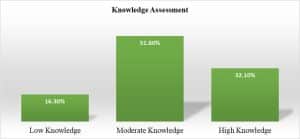
Figure 1: Knowledge assessment
Attitude assessment: A 5-point Likert scale was used to gauge the interns’ attitude towards NSIs, and 21.7% of the respondents had negative attitudes towards NSIs.
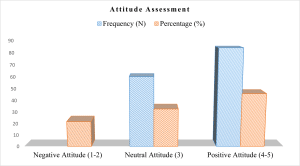
Figure 2: Attitude assessment
Discussion
This study has some implications for the knowledge, attitudes, and practices of nursing interns about NSIs in SGTH. Responding to this study were 184 nursing interns, the majority of whom were between the ages of 25 and 30 years, and males constituted 90% of the sample. This demographic characteristic portrays the study group in a way that may help explain their perception and practice of NSIs.[10]
In findings, it was determined that a considerable percentage of nursing interns bear moderate to high levels of knowledge in NSIs, out of the total 100 points. However, 16.3% of the participants scored low.[11] This points to an area of climate that may trigger a rise in NSIs’ risk, although the difference in comprehension is not significant. Educational work based on prior training to NSIs showed elevated levels of knowledge, which confirms the necessity for the continuation of the implementation of methodological instructions during internships.[12] If integrative advisories on NSIs form part of the planned curriculum, there is potential for enhancing interns’ consciousness and comprehension of the guidelines.[13]
It was also revealed that the overall attitudes of nursing interns towards NSIs were positive, and 45.7 % had a positive attitude towards NSIs. This favorable attitude could be of value in raising a culture of safety within the neighboring healthcare facilities. However, 21.7% of the participants had negative attitude towards HPV vaccination, thus the issue deserves attention. Such attitudes as ‘I don’t like wearing a These attitudes and perceptions may make it difficult and even unsafe for a worker to wear a hard hat or not to take shortcuts that may lead to other forms of injuries.[14] It is therefore suggested that future training programs should not only offer content knowledge as their method of training but also aspire to change for the better the Mint Attitude by seeking to promote the importance of safety in practice and the ramifications of which inapt care can have.
According to the practice assessment, 28.3 % of the nursing interns claimed low compliance with preventive measures concerning NSIs. The above discovery will be of great concern, especially given that health care providers must strictly observe measures which reduce their chances of contracting blood-borne pathogens. However, the level of moderate adherence mentioned by most of the patients (57.6%) should be considered rather weak.[15]
Limitation of the study: The generalizability of this study’s results is somewhat constrained by the fact that this study was undertaken in a single hospital with a relatively small, and mostly male (90%), sample. The data collected by self-report measures is usually influenced by social desirability and, therefore, is not very reliable due to the lack of other types of validation. In using a cross-sectional design, the study lacks the ability to evaluate temporal changes; features such as workload, stress, and organizational policies were not considered. Secondly, the research does not compare the frequency of slurs used by male interns with that used by female interns or experienced health care workers; third, no NSI incident reports from official records were used to verify the results. To fill these gaps, future research should also extend the sample, employ observational techniques, and analyze NSI data from institutions to achieve an improved understanding of NSIs.
Conclusion
This work will fill the knowledge gap as it seeks to examine the level of awareness, perception, and behaviors of nursing interns at SGTH about NSIs. Moreover, the demographic findings highlighted the high percentage of male interns, implying that future strategies of training and raising awareness of safety practices should be applied to all nursing interns appropriately. This outcome supports the need for health literacy improvements and encourages contexts in healthcare facilities. The identified problem of NSIs of interns in the health care units can be addressed by the dissemination of knowledge, a positive attitude towards safety, and adherence to precaution measures. It is also important in protecting and preserving healthcare workers’ welfare, although the efforts can be useful for improving patient care in clinical practice as well.
References
- El-Hay A, Seham A, Abed Allah AK. Effect of implementing training module on competence of internship nursing students’ performance regarding needle stick and sharp injuries safety issues. Tanta Sci Nurs J. 2020;19(1):152-180. doi:10.21608/tsnj.2020.131943 Crossref | Google Scholar
- Keicher F, Zirkel J, Leutritz T, König S. Combatting the occurrence of needle-stick injuries in a medical school: why is it still an issue? BMC Med Educ. 2024;24(1):312. doi:10.1186/s12909-024-05309-1 PubMed | Crossref | Google Scholar
- Eyi S, Eyi İ. Nursing students’ occupational health and safety problems in surgical clinical practice. SAGE Open. 2020;10(1):2158244020901801. doi:10.1177/2158244020901801 Crossref | Google Scholar
- Sabaa MA, Hassan AM, Abd-Alla AK, Hegazy EE, Amer WH. Needle-stick and sharps injuries: awareness, prevalence and risk factors of a global problem in healthcare workers at Tanta University Hospitals, Egypt. Int J Occup Saf Ergon. 2022;28(3):1419-1429. doi:10.1080/10803548.2021.1901445 PubMed | Crossref | Google Scholar
- Rubbi I, Cremonini V, Butuc A, et al. Incidence and type of health care associated injuries among nursing students: an experience in northern Italy. Acta Biomed. 2018;89(7-S):41-49. doi:10.23750/abm.v89i7-S.7812
PubMed | Google Scholar - Rai R, El-Zaemey S, Dorji N, Rai BD, Fritschi L. Exposure to occupational hazards among health care workers in low-and middle-income countries: a scoping review. Int J Environ Res Public Health. 2021;18(5):2603. doi:10.3390/ijerph18052603 PubMed | Crossref | Google Scholar
- Kutubudin AF, Shafei MN, Ibrahim MI, Yaacob NM. Development and validation of the Needlestick Injury Prevention (N-SIP) Module. Cureus. 2024;16(7):e64445. doi:10.7759/cureus.64445 PubMed | Crossref
- Nwankwo TO, Odo GU, Eze MI, Ezeome IV, Umeh UA. Challenges and adherence to standard precautions for prevention of percutaneous injuries and exposure to bloodborne pathogens in clinical practice: a review. Open J Prev Med. 2020;10(8):195-216. doi:10.4236/ojpm.2020.108014 Crossref | Google Scholar
- Schoonwyk PM. Dental assistants’ knowledge, attitude, and practices of infection prevention and control measures in South African oral health care facilities. Masters thesis. Central University of Technology; 2023. Dental assistants’ knowledge, attitude, and practices of infection prevention and control measures in South African oral health care facilities
- Flores PL. When “first, do no harm” fails: A restorative justice approach to workgroup harms in healthcare. (dissertation). University of San Diego; 2022. “When “First, do no harm” fails: A restorative justice approach to workgroup harms in healthcare.
- Naidoo D. Prevalence and associated management approaches of needle-stick injuries amongst public sector dental practitioners in Johannesburg, South Africa. Master’s thesis. University of Johannesburg; 2022. Prevalence and associated management approaches of needle-stick injuries amongst public sector dental practitioners in Johannesburg, South Africa
- Chornow SE. Mentoring program for nurses in the acute care setting. Doctoral dissertation. Bradley University; 2020. Mentoring program for nurses in the acute care setting.
- Gellner PM. Factors contributing to turnover among critical care nurses during the transition to practice period. (master’s thesis). Rhode Island College; 2022. doi:10.28971/562022GP99 Crossref | Google Scholar
- Chen M, Zhang L. Prevalence of needlestick injuries among nursing interns: a systematic review and meta-analysis. Ann Palliat Med. 2021;10(7):7525533-7533. doi:10.21037/apm-21-703 PubMed | Crossref | Google Scholar
- Al-Mugheed K, Farghaly SM, Baghdadi NA, Oweidat I, Alzoubi MM. Incidence, knowledge, attitude and practice toward needle stick injury among nursing students in Saudi Arabia. Front Public Health. 2023;11:1160680. doi:10.3389/fpubh.2023.1160680 PubMed | Crossref | Google Scholar
Acknowledgments
The authors would like to express their gratitude to all participants who generously contributed their time and insights to this study.
Funding
The work had no special funding.
Author Information
Corresponding Author:
Aqsa Iqbal
Department of Nursing
Service Institute of Medical Sciences Lahore, Pakistan
Email: iaqsa5164@gmail.com
Co-Authors:
Sidra Iqbal
Department of Nursing
Service Institute of Medical Sciences Lahore, Pakistan
Shah Hussin
Department of Nursing
Zalan College of Nursing Swat, Pakistan
Authors Contributions
All authors contributed to the conceptualization, investigation, and data curation by acquiring and critically reviewing the selected articles. They were collectively involved in the writing – original draft preparation, and writing – review & editing to refine the manuscript. Additionally, all authors participated in the supervision of the work, ensuring accuracy and completeness. The final manuscript was approved by all named authors for submission to the journal.
Ethical Approval
Ethical clearance to conduct the study was sought from the medical superintendent of the SGTH. All participants provided written informed consent. Thus, they volunteered themselves, and anonymity was also ensured. A separate room was used for data collection to protect privacy.
Conflict of Interest Statement
The authors declare no conflicts of interest.
Guarantor
None
DOI
Cite this Article
Aqsa I, Sidra I, Hussain S. Knowledge, Attitude and Practice of Nursing Internees About Needle Stick Injuries at Saidu Group of Teaching Hospital, Swat. medtigo J Med. 2025;3(1):e30623119. doi:10. 63096/medtigo30623119 Crossref