Author Affiliations
Abstract
Background: Infection control can be understood as the measures that are taken with the aim of reducing the contamination of infections, mainly in the field of health. Controversial preventive measures are practices identifying processes to avoid the onset of infection and its spread, including hand washing and personal protective equipment (PPE) use.
Aim: This study aimed to assess the nurses in health care settings who are applying measures to prevent healthcare-associated infections (HAIs) with a view to determining their efficiency in enhancing patients’ health.
Methods: A quantitative cross-sectional design was used to examine what was being accomplished in infection control and prevention. The study was conducted in the Hayatabad medical complex, Peshawar. Total 200 of the Nurses were taken as a sample size. A Structural questionnaire was used for data collection statistical package for the social sciences (SPSS) software version 22 was used for data analysis and interpretation.
Result: The results indicate that effective infection control reduces HAIs and improves patient recovery and satisfaction. The mean scores for infection control practices demonstrate a high level of adherence among nursing staff. Routine hand hygiene received the highest mean score of 4.5, indicating strong compliance. Wearing gloves and appropriate PPE was also rated positively, with scores of 4.4 and 4.3, respectively.
Conclusion: While adherence to infection control measures is generally high, healthcare institutions must address systemic barriers like staffing and resources. Ongoing training and fostering a culture that prioritizes infection prevention are essential for sustaining effective infection control and improving patient safety.
Keywords
Healthcare-associated infections, Infection prevention techniques, Nursing care practices, Patient health outcomes, Hand hygiene.
Introduction
Infection control can be understood as the measures that are taken with the aim of reducing the contamination of infections, mainly in the field of health. Controversial preventive measures are practices identifying processes to avoid the onset of infection and its spread, including hand washing and PPE use.[1] Patient care coordination concerns contain the functions and duties that involve client care duties, as well as the principles of infection control. Patient health as a concept captures the health status of patients or consumers of healthcare and is a target of HAIs.[2] One must necessarily and effectively adopt basic principles of manipulations involving wiping/scrubbing /cleaning/disinfection/sterilization as the mainstay of
controlling infection risks and dealing with the Global Rise of Multidrug Resistant Organisms (MDROs) and improving patient outcomes.[3]
An infection control model in nursing care has emerged over the years and has been implemented as a means of controlling and preventing HAIs in patient outcomes worldwide.[4] An increase in healthcare-associated illness shows that infection control is very important. It has been estimated that over 2 million patients get one or another type of HAIs annually, and the latter results in severe complications, increased morbidity, longer hospital stay, and higher costs.[5] Since this technique is to be practiced by nurses as the interface of care delivery, it is necessary to examine how these infection prevention processes impact the health of the patients.[6]
Traditionally, the teaching of infection control in nursing was founded on the studies of Florence Nightingale during the Crimean War.[7] It was Nightingale who really put the sanitary ideas into practice for the first time, chiefly in the matter of washing the hands, and the result was the modern method of controlling infectious diseases.[8] In the recent past, these practices have been adapted to changes in medical knowledge, use of antibiotics, and hospital-acquired infections. Currently, infection prevention and control (IPC) occupies an essential place in the curriculum for preparing nursing professionals and focuses on measures, including handwashing, gloves, and the correct handling of medical equipment.[9]
Hand washing and the use of gloves are amongst the most effective infection control measures, with hand washing known to be the single most important method of minimizing the transfer of pathogens.[10] Many scholars have supported the idea that hand washing and the use of alcohol-based hand rubs among health care workers, especially nurses, help reduce the number of infections. Indeed, hand hygiene compliance is a problem in many healthcare facilities, even with the guidelines having been developed.[11] Challenges consist of long working hours, staff shortage, and inadequate availability of washing basins and hand-washing facilities to ensure patient safety.[12]
Methodology
The study used a quantitative cross-sectional study design. The aim was to study infection control and prevention efforts and understand participants’ perceptions of their impact on patient health outcomes. The study was conducted at Saidu group of teaching hospital (SGTH) in Peshawar, Pakistan with a sample size of 200 nurses, calculated using the World Health Organization (WHO) sample size calculator, accounting for a 95% confidence interval, a 5% margin of error, and a 50% response rate. A purposive sampling technique was used to select registered nurses with at least one year of clinical experience from departments such as medical and surgical wards, intensive care units (ICUs), and emergency care. Nurses with less than one year of experience were excluded from their study.
Data collection procedure: The questionnaires were administered in person, and data were collected over a one-month period. A self-administered questionnaire (paper-based) was used for data collection.
The questionnaire consisted of several sections:
- Demographic information: The demographics section sought to determine participants’ age, gender, years of experience, and education level, respectively.
- Infection control practices: Knowledge and performance assessment questions focused on infection prevention and control practices such as handwashing, PPE, and sterilization procedures, and perceived patient education.
- Impact on patient health: This section concerned infection control measures as seen by respondents, their effects on outcomes such as HAIs, patient satisfaction, and general health status. Preferential use of the Likert scale format was made for many items to facilitate the assessment of the participant’s level of agreement or the frequency of specific practices. The credibility and internal consistency of the questionnaire completed via a survey before the main data collection were checked through a pilot study.
Data analysis procedure: Upon completion of data collection, the data were analyzed using SPSS software version 27. Descriptive statistics were employed to summarize demographic information and infection control practices. Inferential statistics, such as chi-square tests, were used to examine the relationships between infection control practices and patient health outcomes. The level of significance was set at p < 0.05.
Ethical consideration: Ethical clearance to conduct the study was sought from the medical superintendent of the SGTH, Swat, Pakistan. All participants provided written informed consent. Thus, they volunteered themselves, and anonymity was also ensured. To maintain anonymity and confidentiality, the participants’ identification was eliminated from the questionnaires, and the data were kept secure. The participants were told that their participation was voluntary and that all responses given would be kept anonymous. The data collected remained accessible only to the researcher and the authorized personnel involved in the study.
Results
The demographic characteristics of the 200 nursing participants reveal a diverse group in terms of age, gender, years of experience, education, and department of work. The majority (30%) of respondents were aged 26-35 years.
| Demographic variable | Frequency (N=200) | Percentage (%) |
| Age | ||
| 18-25 | 25 | 12.5 |
| 26-35 | 60 | 30.0 |
| 36-45 | 55 | 27.5 |
| 46-55 | 40 | 20.0 |
| 56 and above | 20 | 10.0 |
| Gender | ||
| Male | 70 | 35 |
| Female | 130 | 65 |
| Other | ||
| Years of experience | ||
| Less than 1 year | 15 | 7.5 |
| 1-5 years | 85 | 42.5 |
| 6-10 years | 50 | 25.0 |
| 11-15 years | 30 | 15.0 |
| More than 15 years | 20 | 10.0 |
| Highest level of education | ||
| Diploma | 60 | 30.0 |
| Bachelor of science in nursing (BSN) | 130 | 65.0 |
| Master of science in nursing degree (MSN) | 10 | 5.0 |
| Doctorate | ||
| Department | ||
| Medical-surgical | 70 | 35.0 |
| ICU | 50 | 25.0 |
| Emergency department (ED) | 40 | 20.0 |
| Pediatric ward | 30 | 15.0 |
| Other | 10 | 5.0 |
Table 1: Demographic characteristics of participants
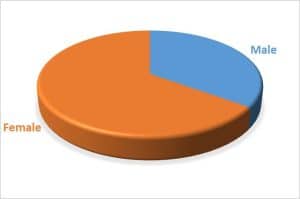
Figure 1: Gender of participants
Infection control practices: The mean scores for infection control practices demonstrate a high level of adherence among nursing staff. Routine hand hygiene received the highest mean score of 4.5.
| Infection control practice | Mean score (1-5) | Standard deviation (SD) |
| Routine hand hygiene before and after patient contact | 4.5 | 0.6 |
| Always wearing gloves when required | 4.4 | 0.7 |
| Appropriate use of PPE | 4.3 | 0.8 |
| Following proper cleaning and sterilization procedures | 4.2 | 0.7 |
| Participation in training or workshops on infection control | 3.8 | 1.0 |
Table 2: Infection control practices
Participants considered infection control practices had a strong influence on patient health outcomes, a score that aligned with their rating. The respondents’ highest mean score of 4.6 was on the belief that effective infection control practice decreases.
| Perceived impact on patient health outcome | Mean score
(1-5) |
SD |
| Effective infection control practices reduce HAIs | 4.6 | 0.5 |
| Patients show improved health outcomes due to infection control | 4.5 | 0.6 |
| Patients receive education about infection prevention | 4.3 | 0.7 |
| Adherence to infection control enhances patient satisfaction | 4.4 | 0.6 |
| Confidence in implementing infection control measures | 4.2 | 0.7 |
Table 3: Perceived impact on patient health outcomes
Several difficulties in the use of infection control measures were described by the participants. Lack of sufficient time was the most often mentioned problem, which may suggest that time pressures compromise compliance with infection control measures; indeed, headaches were reported by 42.5% of respondents.
| Challenges faced in implementing infection control practices | Frequency (N=200) | Percentage (%) | |
| Heavy workloads | 85 | 42.5 | |
| Insufficient staffing | 60 | 30.0 | |
| Lack of resources and supplies | 45 | 22.5 | |
| Limited training opportunities | 35 | 17.5 | |
| Organizational culture hindering adherence | 30 | 15.0 |
Table 4: Challenges faced in implementing infection control practices
Discussion
The findings of the present paper also reaffirm that infection control and prevention strategies are integral parts of nursing practice and their further links to positive patient’ outcomes. These high adherence rates of hand hygiene, PPE usage, and sterilization well reflect the existing literature, which established these measures as effective interventions in preventing HAIs. The findings for routine hand hygiene had a mean score of 4.5; the result suggests that nursing staff perform hand hygiene as recommended by the Centers for Disease Control and Prevention (CDC), although hand hygiene according to some standards is not regarded as routine but crucial during the hand hygiene process.[13]
However, despite the good compliance rates of infection control measures, the mean response score of 3.8 in training and workshop attendance reveals a relative lack of engagement in this type of education.[14] Reviews by researchers have proven that the attainment of professional standards and the ability to embrace new infection control standards require continuous professional development.[15] Besides, inadequate exposure can cause deficiencies in sufficient training and limit access to new approaches and states of knowledge on the subject that is crucial for the nursing staff and, therefore, might harm the patient’s safety. Consequently, it becomes vital for healthcare organizations to provide dedicated time for treatments and workshops that will keep the employees updated on the best infection control practices.[16]
Participants perceived the benefit in relation to improved general health of patients was overall high, and their response indicated that effective infection control measures play a vital role in the prevention of HAIs (mean score of 4.6). Such a discovery emphasizes prior research that shows the causative relationship between enhanced strict infection preventive measures and distinct patient outcomes.[17] Especially of note is patients’ understanding of staff education with respect to infection prevention, scoring a mean of 4.3, suggesting that nursing staff understand their responsibility not just in the delivery of infection control but also in passing this knowledge to the patients. Patient education can promote adherence to measures aimed at preventing infection and increase patients’ awareness of the problem.[18]
However, this study observed several barriers to practice experienced by the nursing staff when enforcing infection control practices. The biggest reported problem was the experiences with high workloads in practical activities, where 42.5% of the respondents indicated. This is worrisome because other studies have pointed out that assigning more duties is likely to contribute to fatigue and thus poor compliance with infection prevention measures.[19] Of these, inadequate staff, limited access to resources, and culture were also other challenges. A synthesis of existing literature showed that inadequate staff nursing decreased the ability of nurses to implement appropriate infection control measures, with subsequent increased HAIs. Therefore, healthcare organizations need to tackle these realities to foster injurious conditions that will enable the standard of infection control.[20]
Also, the evidence provided in the study indicates the necessity of increasing concern regarding staffing and work environment safety for nurses in the healthcare sector. Developing an infection prevention culture can enable organizations to reduce instances of noncompliance with infection prevention measures and therefore enhance patients’ safety.[21] Thus, leadership support and commitment are essential in enhancing infection control as an organizational culture. Nursing staff participation in the formulation and enactment of infection control policies can also enhance the ownership and accountability among staff, hence improving practices.[22]
Therefore, the author of this study highlighted the concept of identifying several measures that can be taken to enhance infection control and prevention methods in the given area of nursing care, noting that infection control has a huge impact on patient health outcomes. Although the usage of IPC is promising, major challenges recognized in this study should be addressed by healthcare organizations. Only institutional resources, staff, and culture could be effectively harnessed to improve infection control and overall patient safety. The direction for future studies is to identify ways of furthering infection prevention in nursing practice, which can help to overcome the stated barriers.
Limitations of the study: There were several main limitations of this study that need to be taken into consideration when analyzing the results. First, this research was done only in one tertiary care hospital in Swat, which would in a way restrict the findings to the same hospital and area only where the study was conducted.
Conclusion
More specifically, this work has emphasized the significance of the measures involved in reducing the incidence of infection and its consequences on the condition of nursing patients. The outcomes also showed that nurses follow the main tenets of infection prevention, including handwashing, proper wearing and utilization of PPE, and proper sterilization procedures. They do that so much in a manner that can greatly lower HAIs, popularly referred to as HAIs, and enhance patient safety. The high compliance rates seen in this study confirm the pump and primary responsibility of nurses in enforcing and observing infection prevention techniques at places of work.
References
- Lee MH, Lee GA, Lee SH, Park YH. A systematic review on the causes of the transmission and control measures of outbreaks in long-term care facilities: back to basics of infection control. PLoS One. 2020;15(3):e0229911. doi:10.1371/journal.pone.0229911 PubMed | Crossref | Google Scholar
- Haque M, McKimm J, Sartelli M, et al. Strategies to prevent healthcare-associated infections: a narrative overview. Risk Manag Healthc Policy. 2020;13:1765-1780. doi:10.2147/RMHP.S269315 PubMed | Crossref | Google Scholar
- Ogunsola FT, Mehtar S. Challenges regarding the control of environmental sources of contamination in healthcare settings in low- and middle-income countries-a narrative review. Antimicrob Resist Infect Control. 2020;9(1):81. doi:10.1186/s13756-020-00750-6 PubMed | Crossref | Google Scholar
- Owen L, Laird K. The role of textiles as fomites in the healthcare environment: a review of the infection control risk. PeerJ. 2020;8:e9790. doi:10.7717/peerj.9790 PubMed | Google Scholar
- Lowe H, Woodd S, Lange IL, et al. Challenges and opportunities for infection prevention and control in hospitals in conflict-affected settings: a qualitative study. Confl Health. 2021;15(1):44. doi:10.1186/s13031-021-00372-8 PubMed | Crossref | Google Scholar
- Lotfinejad N, Peters A, Tartari E, Fankhauser-Rodriguez C, Pires D, Pittet D. Hand hygiene in health care: 20 years of ongoing advances and perspectives. Lancet Infect Dis. 2021;21(8):e209-221. doi:10.1016/S1473-3099(21)00160-9 PubMed | Crossref | Google Scholar
- Assadian O, Harbarth S, Vos M, Knobloch JK, Asensio A, Widmer AF. Practical recommendations for routine cleaning and disinfection procedures in healthcare institutions: a narrative review. J Hosp Infect. 2021;113:104-114. doi:10.1016/j.jhin.2021.04.007 PubMed | Crossref | Google Scholar
- World Health Organization. Infection prevention and control during health care when coronavirus disease (COVID-19) is suspected or confirmed: interim guidance. 2021. Infection prevention and control during health care when coronavirus disease (COVID-19) is suspected or confirmed: interim guidance, 12 July 2021
- Veritti D, Sarao V, Bandello F, Lanzetta P. Infection control measures in ophthalmology during the COVID-19 outbreak: a narrative review from an early experience in Italy. Eur J Ophthalmol. 2020;30(4):621-628. doi:10.1177/1120672120927865 PubMed | Crossref | Google Scholar
- Maillard JY, Bloomfield SF, Courvalin P, et al. Reducing antibiotic prescribing and addressing the global problem of antibiotic resistance by targeted hygiene in the home and everyday life settings: A position paper. Am J Infect Control. 2020;48(9):1090-1099. doi:10.1016/j.ajic.2020.04.011 PubMed | Crossref | Google Scholar
- Mills JP, Marchaim D. Multidrug-resistant gram-negative bacteria: infection prevention and control update. Infect Dis Clin North Am. 2021;35(4):969-994. doi:10.1016/j.idc.2021.07.009 PubMed | Crossref | Google Scholar
- Kumar NR, Balraj TA, Kempegowda SN, Prashant A. Multidrug-resistant sepsis: A critical healthcare challenge. Antibiotics (Basel). 2024;13(1):46. doi:10.3390/antibiotics13010046 PubMed | Crossref | Google Scholar
- AlBahrani S, Saad M, Alqahtani JS, et al. Multicomponent approaches to reduce multidrug-resistant organisms in critical care: determining the ideal strategy. J Epidemiol Glob Health. 2024;14:1371–1380. doi:10.1007/s44197-024-00297-3 PubMed | Crossref | Google Scholar
- Parvez MR. Global rise of multidrug-resistant organisms (MDRO), antibiotics research: MDRO in Bangladesh perspective and way forward. Selinus University of Sciences and Literatures; 2022. Global rise of multidrug-resistant organisms (MDRO), antibiotics research: MDRO in Bangladesh perspective and way forward.
- Iheduru‐Anderson K. Reflections on the lived experience of working with limited personal protective equipment during the COVID‐19 crisis. Nurs Inq. 2021;28(1):e12382. doi:10.1111/nin.12382 PubMed | Crossref | Google Scholar
- Shah AH, Becene IA, Nguyen KT, et al. A qualitative analysis of psychosocial stressors and health impacts of the COVID-19 pandemic on frontline healthcare personnel in the United States. SSM Qual Res Health. 2022;2:100130. doi:10.1016/j.ssmqr.2022.100130 PubMed | Crossref | Google Scholar
- Søvold LE, Naslund JA, Kousoulis AA, et al. Prioritizing the mental health and well-being of healthcare workers: an urgent global public health priority. Front Public Health. 2021;9:679397. doi:10.3389/fpubh.2021.679397
PubMed | Crossref | Google Scholar - Michael N, Nguyen T. Role of nurses in preventing and controlling risk of acquiring healthcare-associated infections from common touch surfaces: An instructional video. 2022. Google Scholar Role of Nurses in Preventing and Controlling Risk of Acquiring Healthcare-Associated Infections from Common Touch Surfaces: An Instructional Video – Theseus
- Lam SK, Kwong EW, Hung MS, Chien WT. Investigating the strategies adopted by emergency nurses to address uncertainty and change in the event of emerging infectious diseases: A grounded theory study. Int J Environ Res Public Health. 2020;17(7):2490. doi:10.3390/ijerph17072490 PubMed | Crossref | Google Scholar
- Campo LK, Remon AR. Knowledge and practices of nurses on the prevention and control of healthcare-acquired infections in a private tertiary hospital in Baguio City. Acta Med Philipp. 2024:1-12. doi:10.47895/amp.vi0.9136
Crossref | Google Scholar
- Kilpatrick M, Hutchinson A, Manias E, Bouchoucha SL. Paediatric nurses’, children’s and parents’ adherence to infection prevention and control and knowledge of antimicrobial stewardship: A systematic review. Am J Infect Control. 2021;49(5):622-639. doi:10.1016/j.ajic.2020.11.016 PubMed | Crossref | Google Scholar
- Kidayu PL. Nurses’ compliance to enhanced infection prevention and control protocols for COVID-19 in the critical care unit at Kenyatta National Hospital. Doctoral dissertation. University of Nairobi; 2022. Nurses’ Compliance to Enhanced Infection Prevention and Control Protocols for Covid-19 in the Critical Care Unit at Kenyatta National Hospital
Acknowledgments
The authors would like to express their gratitude to all participants who generously contributed their time and insights to this study.
Funding
The work had no special funding.
Author Information
Corresponding Author:
Muhammad Shoaib
Department of Nursing
Saidu Group of Teaching Hospital Swat, Pakistan
Email: mshoaib6587@gmail.com
Co-Authors:
Abbas Khan
Department of Nursing
Saidu Group of Teaching Hospital Swat, Pakistan
Yasmeen Musafir
Department of Nursing
Hussan College of Nursing Swat, Pakistan
Shah Hussain
Department of Nursing
Zalan College of Nursing Swat, Pakistan
Authors Contributions
Muhammad Shoaib was responsible for data collection and data analysis. Abbas Khan contributed to data collection. Yasmeen Musafir handled data analysis, while Shah Hussain was also involved in data analysis.
Ethical Approval
Ethical clearance to conduct the study was sought from the medical superintendent of the SGTH Hospital Swat, Pakistan. All participants provided written informed consent. Thus, they volunteered themselves, and anonymity was also ensured. To maintain anonymity and confidentiality, the participants’ identification was eliminated from the questionnaires, and the data was kept secure.
Conflict of Interest Statement
The authors declare no conflicts of interest.
Guarantor
None
DOI
Cite this Article
Muhammad S, Abbas K, Yasmeen M, Hussain S. Impact of infection control and prevention techniques in nursing care on patient health. medtigo J Med. 2025;3(1):e30623129. doi:10.63096/medtigo30623129 Crossref