Author Affiliations
Abstract
Background: Geriatric is a specialty that focuses on the health care of elderly people. The 6-minute walk test (6MWT) is a commonly used test to estimate functional exercise capacity. In the elderly population, the 6-minute walk test has been found to be a highly reliable and acceptable tool. The energy expenditure index (EEI) has been well-documented as an efficient tool for evaluating energy expenditure in various age groups. In various research on geriatrics, the time up and go (TUG) tests have been found to be highly reliable for measuring functional mobility.
Objective: To find out the correlation among aerobic endurance, energy expenditure, and functional mobility in the geriatric population.
Methodology: 200 older adults were included in the study, aged 60 to 80 years, with a mean age of 67.82±4.12 years. Walking heart rate (WHR) & resting heart rate (RHR) for EEI were measured. For the Physical fitness assessment, a 6MWT has been performed for aerobic endurance measurement. For the functional mobility, the TUG test was administered.
Results: The correlation coefficient (r1) between 6MWT & EEI was -0.7474. The correlation co-efficient (r2) between the 6MWT & TUG test was -0.3431. The correlation co-efficient (r3) between TUG test & EEI was 0.2264.
Conclusion: In the geriatric population, aerobic endurance and EEI have an inverse relationship. Aerobic endurance has no such correlation with Functional mobility. EEI has no correlation with Functional mobility.
Keywords
Aerobic endurance, Energy expenditure index, Functional mobility, Geriatric, 6-Minute walk test.
Introduction
As people age, the physical functions of the body involved in the performance of physical activities undergo change. There have been many reports on age-related muscle change, decline in muscle strength and muscle mass with age, the mechanism of age-related muscle weakness at the cellular and molecular levels, and changes in muscle fiber composition and function. Similarly, age-related changes are observed in physical performance. Muscle strength and physical performance differ in people of different ethnicities; therefore, it is important to examine the age-related changes in physical functions. [1] It is important to obtain the mean values of physical function tests for healthy subjects in each age decade because these values can be used as target values for intervention or maintenance of physical function in subjects with decreased physical function due to disease and/or deconditioning.[1]
The aging process is associated with several deleterious changes in body composition and whole-body energy metabolism. The 6MWT is a commonly used test to estimate functional exercise capacity. These changes include an increase in adiposity, loss of muscle mass, decline in physical activity, and a fall in resting metabolic rate.[2] While planning for the assessment and rehabilitation of the geriatric population, we often come across the variable of fatigue, which at times hampers the progression of the treatment. Hence, the amount of energy that is spent in the performance of activities of daily living is of utmost importance in terms of treatment. EEI has been well documented as an efficient tool for the evaluation of the energy expenditure in various age groups. It is an efficient tool in terms of measuring energy expenditure and is also used for various research focusing on nutrition, exercise prescription, and energy pacing techniques in the geriatric population.[3]
The tests that evaluate the functional capacity of physically independent older adults should focus mainly on locomotion activity of daily livings (ADLs) because it is the most frequent and most difficult to perform. It is a combined measure that involves power, velocity, agility, and dynamic balance with the objective of evaluating functional mobility.[4] TUG Test was introduced in 1991 by Podsiadlo and Richardson. Showed that in people aged 65 years or more, the time required for performing the TUG test was prolonged.[1] In various research on geriatrics, the TUG Test has been found to be highly reliable and its correlation with other parameters such as the Berg Balance Scale, stair climbing, and functional indexes, and its predictability to find out the risk of fall and mortality.[5]
Maintaining adequate physical endurance in later years is important to prevent frailty and loss of independence.[6] Many walk tests are being used for the assessment of cardio-respiratory endurance in the elderly population, of which the 6-minute walk test has been found to be a highly reliable and acceptable tool.[7] Hence, the present study tries to encompass the energy expenditure that is required in tasks of daily routine and how aerobic endurance helps the individual to perform the functions.
Methodology
Design: Cross-sectional study
Setting: Community
Sample size: 200
Inclusion Criteria: Age group between 60-80 years, both genders.
Exclusion criteria: Any surgery in the past 6 months, any cardiovascular, neurological disorders.
Ethical approval: The study started after obtaining ethical approval from the institutional ethical committee of the Asok and Rita Patel institute of physiotherapy.
Data collection tools:
- For EEI: Chair, stopwatch, data sheet.
- For 6MWT: Measure tape, stopwatch, 2 square blocks, data sheet.
- For TUG test: Chair, stopwatch, measure tape, data sheet.
Procedure:
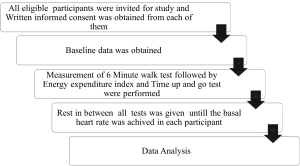
Figure 1: Flow chart of the study
Data collection procedure: All the procedures were explained to all the participants, and after receiving informed consent, baseline data were taken from each of the participants. Demonstration of the outcome measures was done for all the participants who were participating in the study.
Aerobic endurance was measured by performing 6MWT, during which the participants were asked to cover the maximum distance at their comfortable pace in 6 minutes. Then, the measurement of the covered walking distance was done using a measuring tape (No. of laps x the distance of each lap + the additional distance of the last partial lap).

Figure 2: 6MWT
For the Functional mobility measurement, the TUG test was performed with the Participant sitting on the chair with arm support. The participant was asked to stand and walk 3 meters, then turn and go back and sit down on the chair. The time to complete the test was recorded in seconds by a stopwatch.

Figure 3: TUG test
For the energy expenditure during walking, EEI was measured in which the participants were made to sit for 5 minutes; in the last 2 minutes of rest, the RHR was measured. Then she/he was made to walk for 5 minutes. In the last 30 seconds of the walk, WHR was measured.
EEI = WHR-RHR/Walking velocity
Results
200 subjects were taken in this study, of which were included according to the inclusion and exclusion criteria.
|
|
Mean | Standard deviation (SD) |
|
6MWT distance (meter) |
457.77 | 60.08 |
|
EEI (beats/meter) |
0.50 |
0.13 |
| TUG test (seconds) | 12.09 |
1.34 |
Table 1: Mean and SD
|
Gender |
Male | Female | ||
|
Age in Years |
60-70 |
70-80 | 60-70 |
70-80 |
| 6MWT (meter) | 521.64 | 418.20 | 467.59 |
423.14 |
|
EEI (beats/meter) |
0.48 | 0.57 | 0.49 |
0.51 |
|
TUG Test (sec) |
11.55 | 12.97 | 12.08 |
13.09 |
Table 2: Mean value of male and female
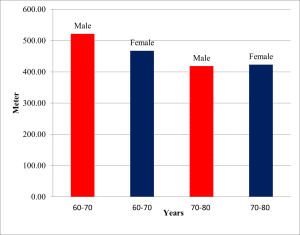
Figure 4: 6MWT distance mean
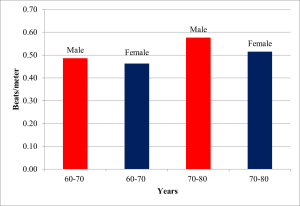
Figure 5: EEI mean
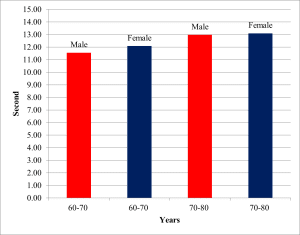
Figure 6: TUG test score mean
| Age (Years) | 6MWT – EEI | 6MWT – TUG | EEI- TUG |
| 60-80 | -0.7474 | -0.3431 | 0.2263 |
Table 3: Correlation coefficient (r)
Discussion
Performance in 6MWT: Graphical presentation shows that the mean values of the 6MWT scores are within normal limits. Their performances on the six-minute walk test are variable in healthy persons over the age of 60 years. All participants walk and the speed at which he or she can cover within a particular time of 6 minutes. The mean distance of the 6MWT 60-70 age groups is greater compared to the 70-80 age groups, because there is a decline in muscle strength and muscle mass with ageing. Ageing produces muscle weakness at the cellular and molecular levels.
Performance in TUG test: From the graphical presentation, it can be interpreted that the TUG test scores are above normal limits. The TUG Test score results were 11.85 seconds for 60-70 age groups for males and 12.08 seconds for females. Similarly, for the 70-80 age group, 12.97 seconds for males and 13.10 seconds for females. On comparing these results with other studies, we think that healthy Indian subjects might perform this test more slowly than healthy people of other ethnicities.
EEI: EEI is highly influenced by changes in the heart rate of geriatric patients. In our study, we found that the EEI values were low compared to the normal values of other studies. It may be their baseline data of height, weight, and cognitive status, which might have influenced our EEI values. Also, the data collection was done at different periods of the day so that temperature variations might have also influenced the values. Thermogenesis is a crucial component in the maintenance of energy homeostasis. Progress has been made in the understanding of the regulation of energy expenditure and thermogenesis, especially the central and hypothalamic control of this vital process. However, circuits and genetic factors involved in thermoregulation that we have not discovered may still exist. Further work is required to fully understand these metabolic pathways and to translate the findings into clinical contexts. Different neuronal populations and nuclei have different effectors and mechanisms to promote physical activities in the form of spontaneous physical activity or exercise, resulting in an increase in energy expenditure.
Correlation: A significant negative correlation was found between 6 MWT and EEI in individuals aged 60-80 years. It might be because the aerobic endurance of all participants has reduced as the energy expenditure increases. As age advances, age-related changes are bound to happen. EEI measurements might have been influenced by the environmental and psychological factors. This influences the heart rate, one of the variables based on which EEI is calculated. Furthermore, EEI values are influenced by the walking speed of the participants during the allotted time of 5 minutes in the present study. TUG test involves two activities of sit-to-stand and walking. From the results of our study, we found that the TUG test scores were normal in individuals aged 60-80 years. There was significant negative correlation between 6MWT and TUG test in the majority of the groups of the study, The time taken to complete the task is strongly correlated to level of functional mobility of an individual because to walk such a small distance of 30 m, the cardio respiratory status of the participate was challenged to the maximum, which might have given the negative correlation between the two tests. This study was conducted only on healthy community-dwelling people; it is necessary to investigate aerobic endurance, energy expenditure during walking, and functional mobility in unhealthy people and compare the results.
Conclusion
In the geriatric population, aerobic endurance and energy expenditure index have an inverse relationship. Aerobic endurance has no such correlation with Functional mobility. EEI has no correlation with functional mobility.
References
- Tsubaki A, Kubo M, Kobayashi R, Jigami H. Age-related changes in physical function in community-dwelling people aged 50-79 years. J Phys Ther Sci. 2010;22:23-27. doi:10.1589/jpts.22.23 Crossref | Google Scholar
- Pedrosa R, Holanda G. Correlation between the walk, 2-minute step, and TUG tests among hypertensive older women. Braz J Phys Ther. 2009;13(3):252-256. doi:10.1590/S1413-35552009005000030 Crossref | Google Scholar
- Sergi G, Coin A, Mulone S, et al. Resting energy expenditure and body composition in bedridden institutionalized elderly women with advanced-stage pressure sores. J Gerontol A Biol Sci Med Sci. 2007;62(3):317-322. doi:10.1093/gerona/62.3.317 PubMed | Crossref | Google Scholar
- Bohannon RW. Reference values for the timed up and go test: a descriptive meta-analysis. J Geriatr Phys Ther. 2006;29(2):64-68. doi:10.1519/00139143-200608000-00004 PubMed | Crossref | Google Scholar
- Rose J, Gamble JG, Lee J, Lee R, Haskell WL. The energy expenditure index: a method to quantitate and compare walking energy expenditure for children and adolescents. J Pediatr Orthop. 1991;11(5):571-578. The energy expenditure index: a method to quantitate and compare walking energy expenditure for children and adolescents
- Bautmans I, Lambert M, Mets T. The six-minute walk test in community dwelling elderly: influence of health status. BMC Geriatr. 2004;4:6. doi:10.1186/1471-2318-4-6 PubMed | Crossref | Google Scholar
- Enright PL. The six-minute walk test. Respir Care. 2003;48(8):783-785. The six-minute walk test
- Steffen TM, Hacker TA, Mollinger L. Age and gender-related test performance in community-dwelling elderly people: Six-Minute Walk Test, Berg Balance Scale, Timed Up & Go Test, and gait speeds. Phys Ther. 2002;82(2):128-137. doi:10.1093/ptj/82.2.128 PubMed | Crossref | Google Scholar
- Starling RD, Poehlman ET. Assessment of energy requirements in elderly populations. Eur J Clin Nutr. 2000;54 Suppl 3:S104-S111. doi:10.1038/sj.ejcn.1601031 PubMed | Crossref | Google Scholar
- Troosters T, Gosselink R, Decramer M. Six minute walking distance in healthy elderly subjects. Eur Respir J. 1999;14(2):270-274. doi:10.1034/j.1399-3003.1999.14b06.x PubMed | Crossref | Google Scholar
- Er R, Jones J. The reliability and validity of a 6-minute walk test as a measure of physical endurance in older adults. J Aging Phys Act. 1998;6:363-375. doi:10.1123/japa.6.4.363 Crossref | Google Scholar
- Goran MI, Poehlman ET. Endurance training does not enhance total energy expenditure in healthy elderly persons. Am J Physiol. 1992;263(5 Pt 1):E950-E957. doi:10.1152/ajpendo.1992.263.5.E950 PubMed | Crossref | Google Scholar
- Tran LT, Park S, Kim SK, Lee JS, Kim KW, Kwon O. Hypothalamic control of energy expenditure and thermogenesis. Exp Mol Med. 2022;54(4):358-369. doi:10.1038/s12276-022-00741-z PubMed | Crossref | Google Scholar
Acknowledgments
Not reported
Funding
There was no source of funding from anyone for the present study.
Author Information
Corresponding Author:
Nainesh Khasatiya
Department of Physiotherapy
Sports Authority of Gujarat, India
Email: khasatiyanainesh@gmail.com
Co-Authors:
Dhruv Dave, Dipika Rahodiya
Department of Physiotherapy
Ashok and Rita Patel Institute of Physiotherapy, Gujarat, India
Authors Contributions
All authors contributed to the conceptualization, investigation, and data curation by acquiring and critically reviewing the selected articles. They were collectively involved in the writing – original draft preparation, and writing – review & editing to refine the manuscript. Additionally, all authors participated in the supervision of the work, ensuring accuracy and completeness. The final manuscript was approved by all named authors for submission to the journal.
Informed Consent
Not applicable
Conflict of Interest Statement
Not applicable
Ethical Approval
Ethical approval from the institutional ethical committee of the Asok and Rita Patel institute of physiotherapy.
Guarantor
None
DOI
Cite this Article
Nainesh K, Dhruv D, Dipika R. Correlation Between Aerobic Endurance, Energy Expenditure During Walking, and Functional Mobility in the Geriatric Population. medtigo J Neurol Psychiatry. 2024;1(1):e3084112. doi:10.63096/medtigo3084112 Crossref